This is a demo store. No orders will be fulfilled.


 US/Global
  CAN
CANFree Reproducibles
Doable Differentiation
Twelve Strategies to Meet the Needs of All Learners
Differentiating for students’ learning preferences can often seem too complex and complicated for too little gain. Learn a better way forward with the guidance of Doable Differentiation. Author Jane A.G. Kise provides a series of straightforward, high-reward strategies that K–12 educators like you successfully use in their daily practice to support, engage, and challenge students with diverse learning styles.
Benefits
- Understand the benefits of differentiation and how to implement differentiated instruction simply and effectively.
- Learn students’ preferred cognitive processing styles to better tailor differentiated lesson plans for all learners’ needs.
- Discover 12 categories of research-based differentiation strategies to implement immediately.
- Provide students with a variety of accessible options for processing information, engaging in higher-level thinking, and demonstrating learning.
- Engage learners and develop their proficiency and self-efficacy.
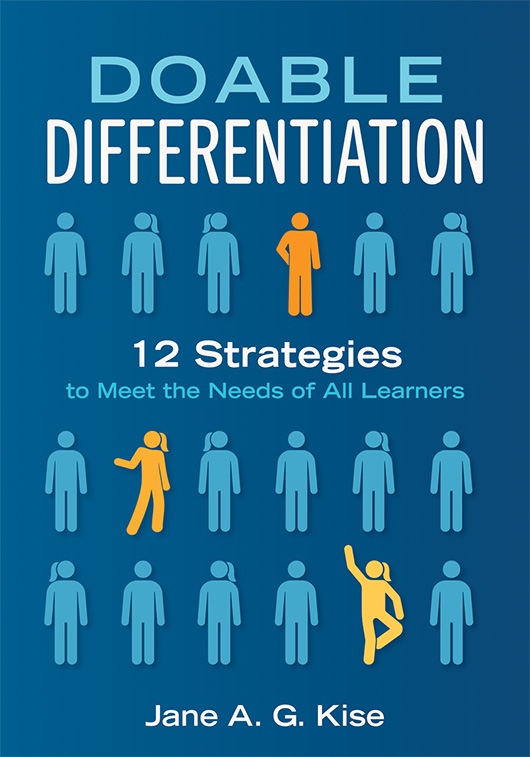
Table of Contents
Introduction: What Makes Differentiation Doable?
Chapter 1: Cognitive Processes and Effective Differentiation
Chapter 2: Clear Learning Goals and Expectations
Chapter 3: Choice
Chapter 4: Wait Time
Chapter 5: Unambiguous Instruction
Chapter 6: Pressure-Prompted Accommodations
Chapter 7: Student-Centered Discussions
Chapter 8: Curiosity Creators
Chapter 9: Open Questions
Chapter 10: Concept Maps
Chapter 11: Big Notes
Chapter 12: Moveable Organizers
Chapter 13: Planned
Chapter 14: Talking to Write
Chapter 15: Two-Step Differentiation
Epilogue
PRINTABLE REPRODUCIBLES
- Figure 1.1: The cognitive processing styles
- Figure 1.5: The cognitive processes and doable differentiation strategies
- Big Ideas in Early Mathematics
- Table 3.1: Motivating Word Pairs
- Figure 7.1: Sample sentence-starters poster
- Figure 7.2: Sample-prompts poster for primary students and English learners
- Tea Party Example Sentences
- Figure 9.2: Sample rubric for class evaluation of a discussion
- Figure 11.2: A four corners chart on big notes
- Figure 15.1: Original task rigor lesson plan
- Figure 15.4: Planning template for teaching around the cognitive processes
- Figure 15.5: Lesson plan for teaching around cognitive processes—Primary-grade example
- Figure I.1: The Elements of STEAM2
SUGGESTED RESOURCES
Books
- DuFour, R., DuFour, R., Eaker, R., Many, T., & Mattos, M. (2016). Learning by doing: A handbook for Professional Learning Communities at Work (3rd ed.). Bloomington, IN: Solution Tree Press.
- Fisher, D., Frey, N., & Lapp, D. (2012). Teaching students to read like detectives: Comprehending, analyzing, and discussing text. Bloomington, IN: Solution Tree Press.
- Fuller, A., & Fuller, L. (2021). Neurodevelopmental differentiation: Optimizing brain systems to maximize learning. Bloomington, IN: Solution Tree Press.
- Grift, G., & Major, C. (2020). Teachers as architects of learning: Twelve constructs to design and configure successful learning experiences (2nd ed.). Bloomington, IN: Solution Tree Press.
- Kise, J. A. G. (2019). Holistic leadership, thriving schools: Twelve lenses to balance priorities and serve the whole student. Bloomington, IN: Solution Tree Press.
- Kise, J. A. G., & Russell, B. (2010). Creating a coaching culture for professional learning communities. Bloomington, IN: Solution Tree Press.
- McTighe, J., & Curtis, G. (2019). Leading modern learning: A blueprint for vision-driven schools (2nd ed.). Bloomington, IN: Solution Tree Press.
- Sousa, D. A., & Tomlinson, C. A. (2018). Differentiation and the brain: How neuroscience supports the learner-friendly classroom (2nd ed.). Bloomington, IN: Solution Tree Press.
- Townsley, M., & Wear, N. L. (2020). Making grades matter: Standards-based grading in a secondary PLC at Work. Bloomington, IN: Solution Tree Press.
- White, K. (2019). Unlocked: Assessment as the key to everyday creativity in the classroom. Bloomington, IN: Solution Tree Press.
- Wiliam, D. (2011). Embedded formative assessment. Bloomington, IN: Solution Tree Press.
- Wiliam, D. (2018). Embedded formative assessment (2nd ed.). Bloomington, IN: Solution Tree Press.


